
The Augusta Rule: Rent Your Home to Your Business Tax-Free
The Augusta Rule, found at Section 280A(g) of the tax code, lets you rent your personal residence to your own business for 14 days or fewer each year, take a legitimate rent deduction inside the business, and receive that rent personally without reporting it as income. It is one of the few places in the code where a dollar is deductible on one side and tax-free on the other. It also has a short list of rules that owners break constantly, and the Tax Court has been unsympathetic when they do.
What is the Augusta Rule, and why is it called that?
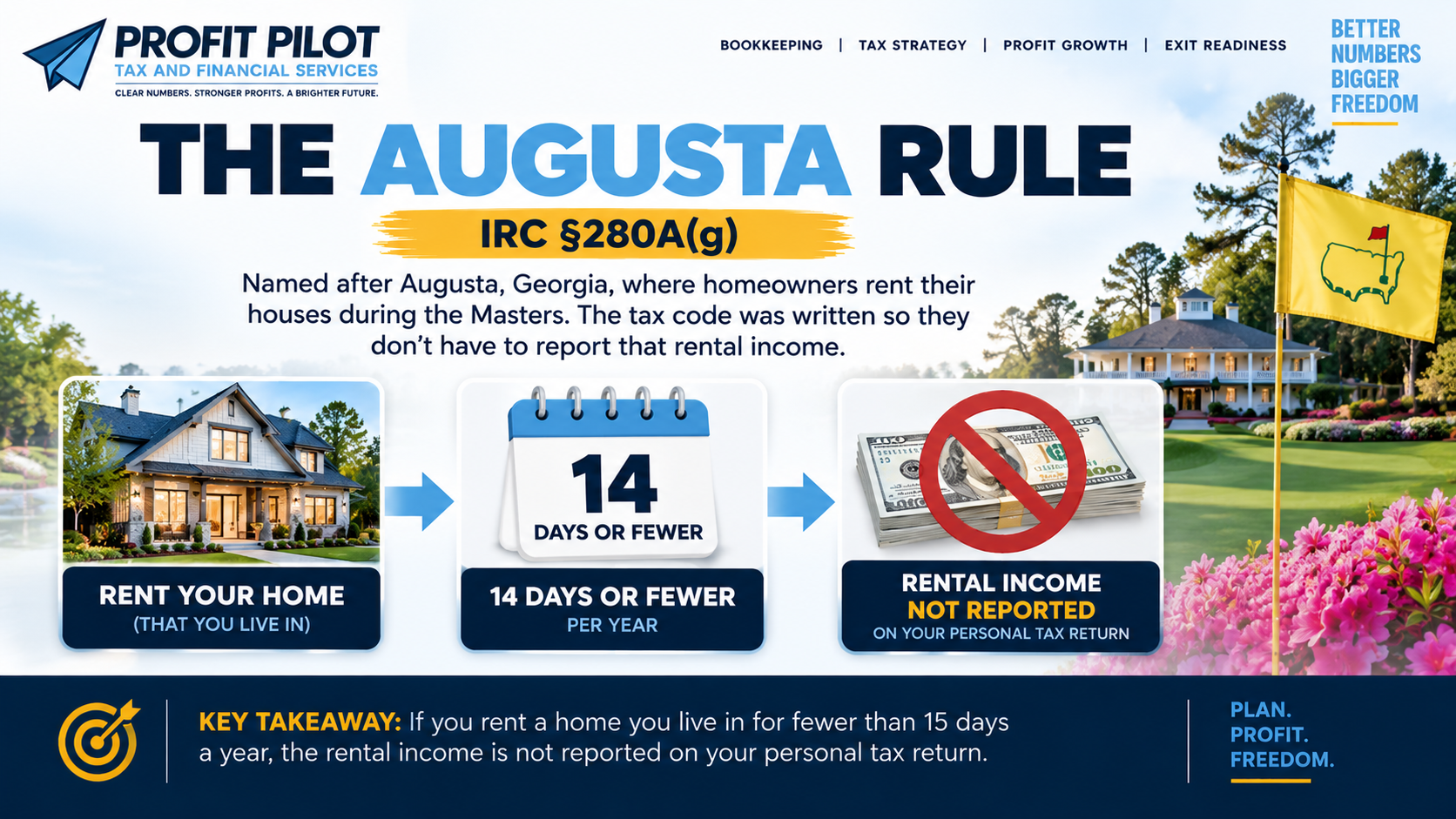
The nickname comes from Augusta, Georgia. Every April, the Masters golf tournament rolls into town and homeowners rent their houses to visitors for the week at prices that would make a hotel blush. Congress carved out a rule so those homeowners would not have to report that income, and the provision became known as the Augusta Rule. The actual citation is Internal Revenue Code Section 280A(g), and it says something simple: if you rent a dwelling unit that you use as a residence for fewer than 15 days during the year, you do not report the rental income at all, and you do not deduct the rental expenses either.
Here is the part that matters for a business owner. Nothing in that rule says the renter has to be a stranger from out of town. If your business is a separate taxpayer from you, your business can be the renter. The business pays you rent for the use of your home, deducts it as an ordinary and necessary business expense, and you exclude the income personally under 280A(g).
As I tell my clients, that is a genuinely unusual outcome. Most tax planning is about timing, moving a deduction from next year into this year. This one is not timing. If it is done correctly, the money simply never gets taxed.
Who actually qualifies, and who does not?
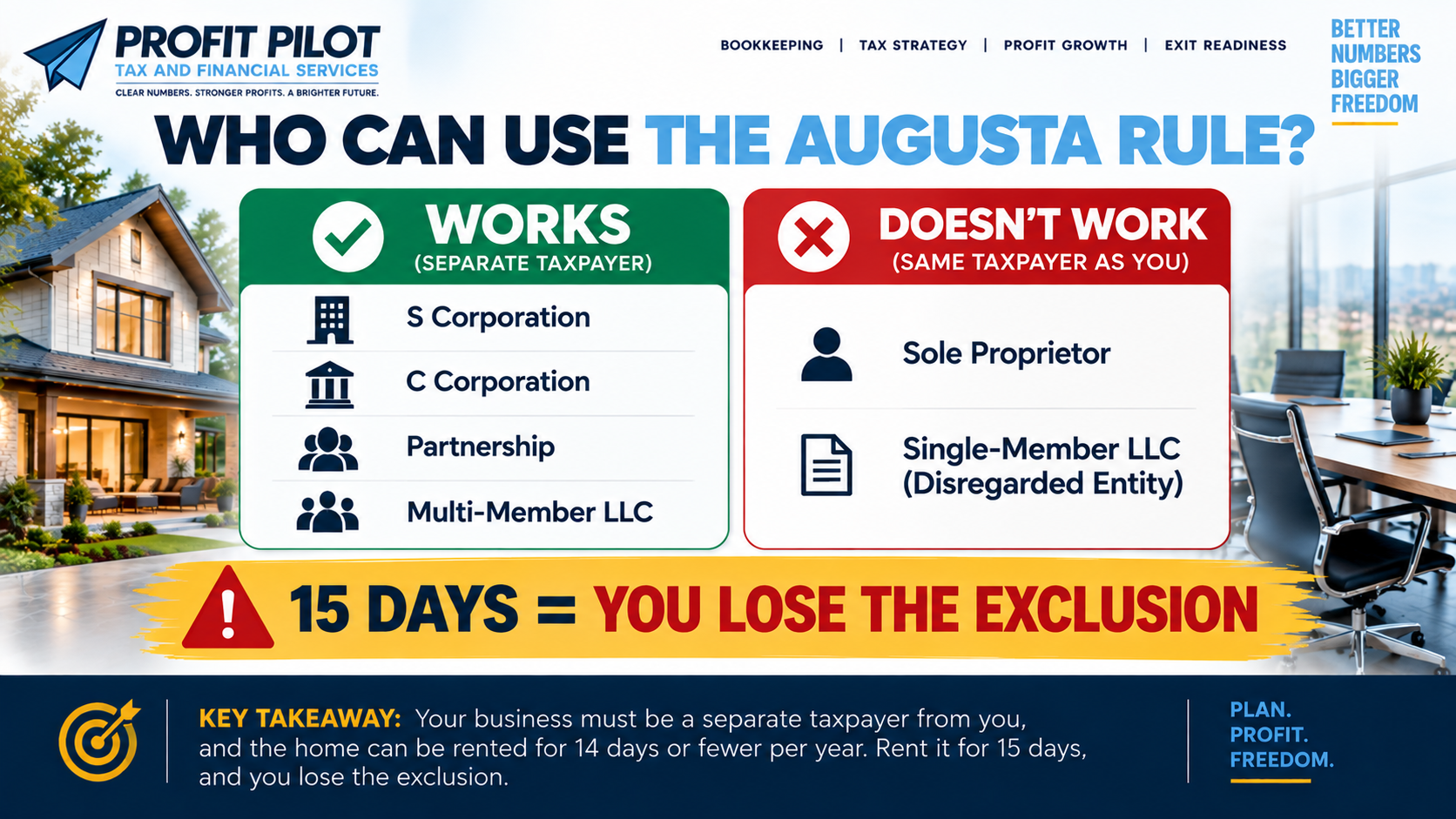
This is where the strategy falls apart for a lot of owners before it ever starts, so let us handle it first.
Your business has to be a separate taxpayer from you. That means an S corporation, a C corporation, a partnership, or a multi-member LLC. If you operate as a sole proprietor, or as a single-member LLC that has not elected to be taxed as an S corporation (check out our article on S corps vs LLCs), the IRS treats the business and you as the same taxpayer. You would be writing yourself a check, deducting it on Schedule C, and excluding it on your 1040. No second party exists, so there is nothing to deduct. Owners hear about this strategy at a conference, go home excited, and discover their entity structure does not support it.
You also have to actually use the home as a residence. Your primary home works. A vacation home you use works personally. A pure rental property you never occupy does not, because 280A applies to dwelling units used as a residence.
And the 14-day limit is a hard wall, not a guideline. The exclusion applies when the home is rented for fewer than 15 days in the year. Rent it for 15 days and the exclusion vanishes entirely, not just for the extra day. All of it becomes reportable income. If you also rent the place out on a short-term rental platform, those days count toward the same 14.
How much can you actually charge, and what does it save?

Rent has to be at fair market value for comparable space, and this is the single most common failure point. Let me walk through a hypothetical so the numbers are concrete. These figures are illustrative only, and your own result will depend on your location, your entity, your income, and your facts.
Marcus runs an S corporation in Austin doing about $4 million in revenue. He holds a monthly leadership and strategy meeting with his three managers, plus an annual planning session. That is 12 meeting days a year, comfortably under 14. He gathers three written quotes from local venues that would host a half-day meeting for a group his size: a hotel meeting room, a coworking conference suite, and a private event space. The quotes come back at roughly $1,300, $1,500, and $1,700 for the day, including the setup his meetings require. He sets the rate at $1,500 and saves the quotes in the file.
Twelve days at $1,500 is $18,000. The S corporation deducts $18,000 as rent. Marcus receives $18,000 and, under 280A(g), reports none of it.
Now the honest math on the savings, because this is where a lot of the marketing overstates things. Marcus's business income flows through to his personal return, so an $18,000 deduction reduces his pass-through income by $18,000. If he qualifies for the Section 199A qualified business income deduction, that deduction was worth 20% of his business income, so shrinking the income also shrinks the 199A deduction by about $3,600. His net taxable income drops by roughly $14,400 rather than the full $18,000. At a 37% marginal federal rate, that is about $5,328 of federal tax he does not pay. Texas has no personal income tax, so for a Texas owner the federal number is the main event.
Five thousand dollars is not life-changing money for a business Marcus's size. It is also five thousand dollars for meetings he was already holding, in a house he already owns, with an afternoon of paperwork. I like strategies with that ratio.
What does the IRS actually look for, and where do owners get burned?

The cautionary tale here is a real Tax Court case, Sinopoli v. Commissioner, decided in 2023. An S corporation paid its shareholders roughly $291,000 over less than three years to rent portions of their homes for monthly meetings. The court did not rule that the Augusta Rule is invalid, and it did not say the meetings never happened. It said the rent was not supported. The shareholders had priced the space themselves without third-party comparables, and they could not produce credible minutes, agendas, or calendars proving the frequency and business purpose of the meetings. The IRS substituted local hotel rates, the court accepted about $500 per substantiated meeting, and the allowed deduction came down from roughly $291,000 to roughly $16,500.
Read that outcome again. The concept survived. The documentation did not. The court also made the point that 280A(g) is not a mechanism for pulling corporate earnings out tax-free under the label of rent.
So the file you build is the strategy. At minimum, you want a written rental agreement between you and the business stating the dates, the rate, and the space being rented. You want third-party evidence of the rate, meaning actual written quotes or listings from comparable local venues, refreshed every year or two because rates move. You want meeting evidence for each day: an agenda, minutes or notes, the attendee list, and a calendar entry. You want a real business purpose, not "we ate barbecue by the pool." And you want an actual payment from the business bank account to your personal account on or near the rental date, not a single lump-sum transfer in late December.
One more practical wrinkle. If the business issues you a Form 1099 for the rent, the IRS matching system is now expecting to see that amount on your return. Many preparers handle this by reporting the rent on Schedule E with an offsetting entry and a statement referencing Section 280A(g), so the matching system is satisfied, and the exclusion is still claimed. Whether to issue a 1099 at all, and how to report it if you do, is a conversation for your own preparer before the year ends, not the following April.
Finally, don't use the same space for this that you are already claiming as a home office. If you deduct a room as a home office, renting that same room to the business is asking for trouble. Use common areas that aren't part of any other deduction.
How does this fit into building a business worth selling?

Honestly, the Augusta Rule is not a value-building strategy. It does not raise your multiple, it does not reduce owner dependence, and no buyer is going to pay more for your company because you rented your dining room to it twelve times.
What it does is free up cash inside a structure you already have, with almost no friction. And there is a quieter benefit worth naming. The discipline this strategy demands- real agendas, real minutes, real board and leadership meetings documented on a calendar- is exactly the discipline that shows up in diligence when you sell. Buyers and their quality of earnings teams look for a company that operates like a company. An owner who has been running documented monthly leadership meetings for five years has a governance story. An owner who has not is going to spend the diligence period reconstructing one.
So take the deduction. But build the file properly, because the file is worth more than the deduction.
Key takeaways
Section 280A(g) lets you rent your residence to your business for 14 days or fewer per year, with the rent deductible to the business and excluded from your personal income.
Your business must be a separate taxpayer. Sole proprietors and disregarded single-member LLCs do not qualify.
Fourteen days is an absolute limit. Hit 15 and the entire exclusion is lost for the year.
Rent must be at fair market value, supported by third-party comparables you actually collected and saved.
Documentation carries the strategy: a written agreement, rate comparables, agendas, minutes, attendee lists, and real payments on real dates.
In Sinopoli v. Commissioner, a claimed deduction of roughly $291,000 was cut to roughly $16,500 because the rate and the meetings were not substantiated.
The realistic annual benefit for most owners is a few thousand dollars, which is good value for the effort but not a reason to reorganize your business.
Frequently asked questions
How many days can I really rent my home to my business? Fourteen or fewer during the tax year. The statute applies when the dwelling is rented for fewer than 15 days. Any other rental days for the same home, including short-term rental platform bookings, count toward the same total, and crossing the line makes all of the year's rental income reportable.
Can I use the Augusta Rule if I am a sole proprietor or a single-member LLC? Generally no. In both cases, you and the business are the same taxpayer for income tax purposes, so there is no separate party paying rent. Owners in this position sometimes consider whether an S corporation election makes sense for other reasons, and if it does, this becomes an available side benefit. That is a decision to make with your own advisor based on your full picture, not for this strategy alone.
How do I figure out a defensible daily rate? Get written quotes or current listings from at least two or three comparable local venues that could host the same kind of gathering for the same number of people, and save them with your return file. Do not estimate it yourself, and do not use a rate someone quoted you three years ago. The Sinopoli case turned on exactly this point.
What counts as a legitimate business meeting? Something the business genuinely needs to do: leadership or management meetings, annual strategic planning, board meetings, partner meetings, training sessions, client or team events with a business agenda. Each one should have an agenda, notes or minutes, and a record of who attended. A family gathering with a fifteen-minute business conversation attached is not a business meeting.
Do I have to report the income anywhere? If no Form 1099 is issued, the excluded rent generally does not appear on your return at all. If the business does issue a 1099, most preparers report the amount and offset it with an explanatory entry referencing Section 280A(g) so the IRS matching system reconciles. Coordinate this with your preparer before year-end.
Can I rent my vacation home or lake house to the business too? Possibly, if you use it as a residence and the business has a real reason to meet there. Be aware that the 14 days apply per dwelling unit, and also that a retreat at a lake house invites more scrutiny of business purpose than a quarterly planning session at your primary home. The agenda and the attendee list need to hold up on their own.
About Jeff Kikel
Jeff Kikel, ChFC, CRPC, ATA, is the founder of Profit Pilot Tax and Freedom Day Wealth Management in the Austin, Texas area. He works with business owners on tax strategy, value building, and planning a business exit that actually funds the life they want afterward. Jeff is the co-host of The Cents of Things podcast and writes and speaks regularly on business value, taxes, and retirement income.
If you want to know whether the Augusta Rule fits your entity structure, and how to build a file that would hold up if anyone ever asked, Profit Pilot can walk through it with you before year-end. Learn more at www.ProfitPilotTax.com.
This article is for educational purposes only and is not individualized tax, legal, or investment advice. Tax law is complex and changes over time, and the right answer depends entirely on your specific facts, entity structure, income, and location. The dollar figures used above are hypothetical illustrations, not projections, and no particular outcome is promised or guaranteed. Please consult your own tax advisor, attorney, or financial professional before acting on anything you read here.
Sources
Augusta Rule: Avoiding Audit Using 280A(g) Home Rental Deduction (Fraim, Cawley & Company, CPAs)
Understanding the Internal Revenue Code's "Augusta Rule" (Adams and Reese)
Recent Tax Court Cases Addressing the "Augusta Rule" (Kim & Rosado)
Can I Rent My Home to My Business? Augusta Rule Guide (Keeper)
Section 280A Deduction Explained: How the Augusta Rule Works (Anderson Advisors)